

Making Space for Growth: Student Internships at the RCAH Center for Poetry
May 1, 2026 - Gabrielle Yeary
The RCAH Center for Poetry, despite its wide-reaching presence across campus, sits tucked into a modest office space on the second floor, right at the intersection of Snyder and Phillips Halls. Its physical footprint may be small, but the energy within its walls feels expansive. Shelves stretch along the room, crowded with hundreds of books whose spines reflect decades of voices, styles, and traditions. Manuscripts, event flyers, and well-loved collections sit side by side, adding to the overall scholarly atmosphere.
For those unfamiliar with RCAH, the space can initially feel formidable, even intimidating. Poetry itself often carries that weight for newcomers—misunderstood as distant or exclusive. Yet the Center quickly dispels that impression. What may seem daunting at first glance becomes, for interns and regular visitors alike, a place of welcome and belonging. Over time, the office transforms from an academic workspace into something more intimate: a home base for ideas, conversations, and artistic growth.

U.S. Poet Laureate Juan Felipe Herrera chats with interns Arzelia Williams and Grace Carras in the Center for Poetry, 2016.
Founded in 2007 by RCAH professor and inaugural director, Anita Skeen, the Center for Poetry was established with a clear and enduring mission: to connect people to poetry as a living, breathing part of their everyday lives. Rather than confining poetry to classrooms or textbooks, the Center has consistently sought to bring it into public spaces, conversations, and community events. That founding intention remains unchanged. In 2010, the Center further strengthened its commitment to student engagement by welcoming its first cohort of student interns, inviting them not only to witness the work of literary programming but to help make it their own. Since then, the Center has continued to serve as both a hub for poetic expression and a training ground for students eager to carry that work forward.
“Anita, Linnea, and Laurie would help edit my work, so I got to learn from them, too. I started out with pretty basic profile stories, and later was able to use more creative interviewing and writing techniques to make my stories richer and more interesting.” —Kelsey Block, Center for Poetry intern, 2013-2016.
What sets the Center for Poetry apart from many traditional internships is its commitment to shaping the work around its students. Rather than assigning fixed roles, the Center adapts each year to reflect the interns’ interests and professional goals, creating space for exploration, creativity, and growth. For some interns, the work they pursued at the Center for Poetry allowed them to mirror their academic paths.
Kelsey Block, who interned from 2013 to 2016 while studying Journalism and Arts and Humanities at RCAH, found a way to blend both disciplines through her role at the Center. Her academic training in reporting and storytelling became a natural extension of the Center’s mission to amplify poetic voices and document its community impact.
During her time there, Block played a key role in establishing the Center for Poetry’s blog, helping to shape it into a platform that highlighted the organization’s programs, workshops, and public events. She was responsible not only for pitching story ideas but also for researching, interviewing participants, and crafting engaging articles that captured the spirit of each initiative. Through her writing, she translated live readings and community workshops into lasting narratives, ensuring that the Center’s work reached audiences beyond those physically in attendance.
“Anita [Skeen], Linnea [Jimison], and Laurie [Hollinger] would help edit my work, so I got to learn from them, too,” Block said. “I started out with pretty basic profile stories, and later was able to use more creative interviewing and writing techniques to make my stories richer and more interesting.”
Since then, Block now works in higher education helping students live out their college experience. She attributes this decision to her own difficulties during undergraduate as a first generation student.
“I am at a point in my life where poetry plays more of a role than I could have ever imagined. I've been writing poems and short stories since I was a kid, but working as an intern really exposed me to the variety of ways people made careers and found joy in writing poetry.” —Alexis Stark, Center for Poetry intern, 2016-2018
Jenny Crakes joined the Center in 2013 as a junior majoring in Arts and Humanities with a concentration in Professional Writing. She first met Anita Skeen as a prospective student while sitting in on one of her classes, an experience that later led her to become part of the team as an education coordinator. In this role, Crakes helped plan and lead interactive creative writing workshops for both children and senior citizens, fostering spaces for storytelling and self-expression. Grounded in community engagement, her work focused on connecting the Greater Lansing area with poetry, extending the Center’s mission beyond campus and into the lives of local residents.
“Both Laurie and Anita encouraged us interns to pursue projects we were passionate about. I knew I wanted to be a writer, so I wrote a lot of blog posts for the website and helped with interviews of visiting poets," said Alexis Stark, once a student intern who now works as a multimedia journalist for School News Network based in Kent County, Michigan.
As an intern, Stark focused on writing articles about events, similar to Block’s work. She also managed much of the photography for events and visiting poets. Now, Stark has two published poetry collections. In addition to her journalism work, she serves as a teaching artist at The Diatribe, where she brings poetry into classrooms.
“I am at a point in my life where poetry plays more of a role than I could have ever imagined,” Stark said. “I've been writing poems and short stories since I was a kid, but working as a [Center for Poetry] intern really exposed me to the variety of ways people made careers and found joy in writing poetry.”
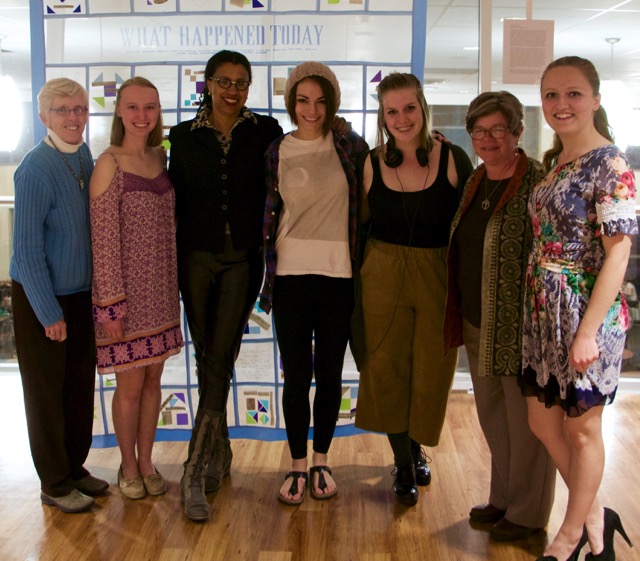
(left to right) Center for Poetry founding director Anita Skeen with intern Alexis Stark, visiting poet Robin Coste Lewis, interns Grace Carras and Sarah Teppen, assistant director Laurie Hollinger, and intern Kelsey Block, at a reception during Coste Lewis's 2016 residency.
Some interns, despite starting with local work, have expanded their reach in unexpected ways. Kaylee McCarthy is one example, having spent the past four years living between Austria and Germany. In 2025, she continued the Center for Poetry’s mission by teaching English to kindergarteners in Vienna. McCarthy interned at the center from 2019 to 2021 after first meeting Anita Skeen during a Poets Laureate course. In her final year as an undergraduate, she studied in Germany, then went on to participate in a U.S. Teaching Assistantship program through Fulbright Austria for two years.
Now, McCarthy is exploring creative opportunities in Illinois, where she currently lives, and is preparing for an upcoming move to St. Louis, Missouri.
“My experience at the CfP has definitely helped me in my years since graduation…I’ve carried with me the feeling of creative possibility that’s alive at the CfP, and I’m looking to find that kind of community again,” McCarthy said.
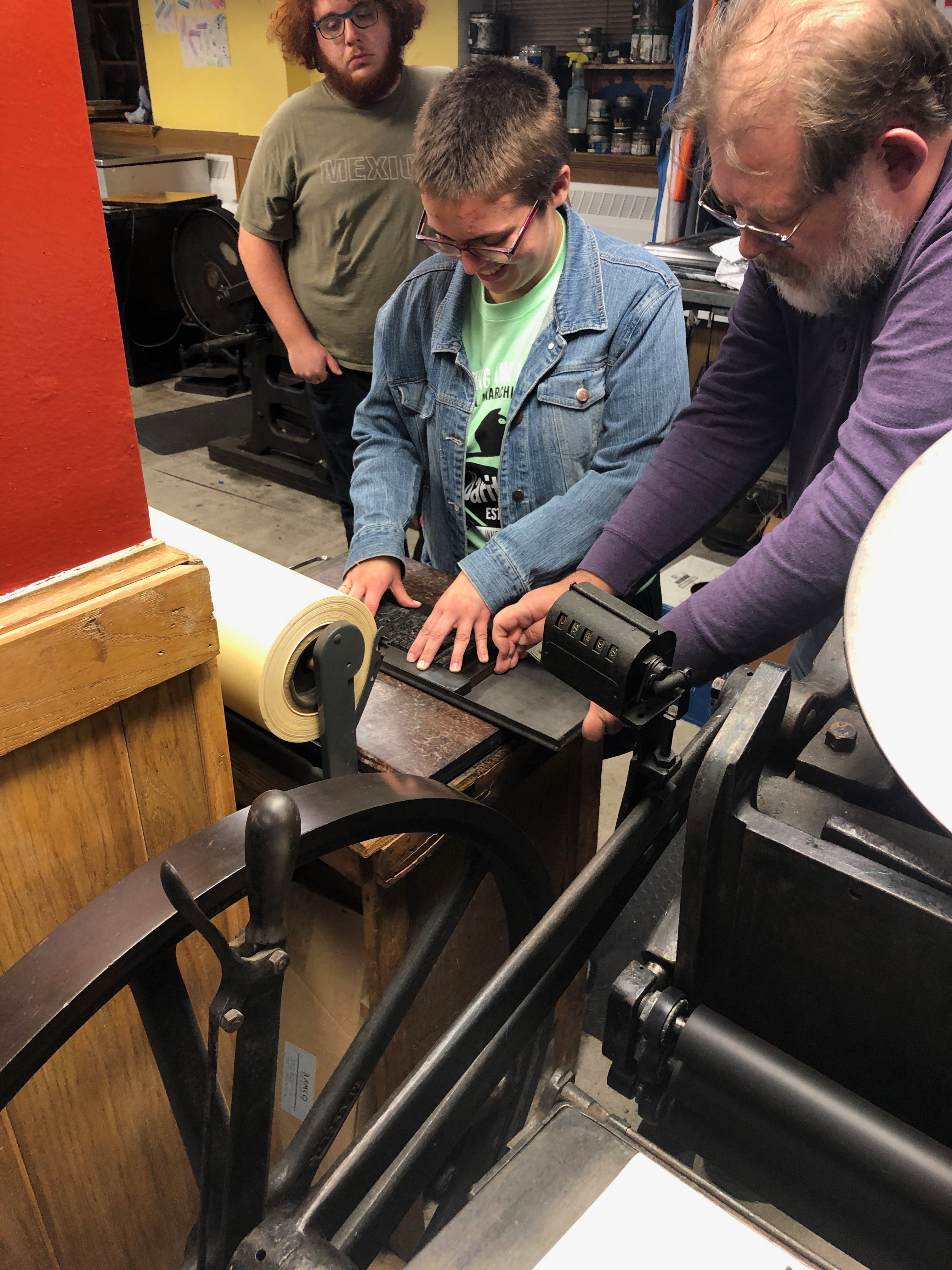
This 2019 photo shows intern Kaylee McCarthy getting an assist from printer Arie Koelewyn (right) moving lead type from the galley, as intern Fabrizzio Torero looks on.
One of the defining features of the RCAH Center for Poetry is its continued use of broadsides and letterpress printing. Currently, student intern Frank Jeffries collaborates with MSU’s student print club, the Spartan Printing Association, as well as with printer Arie Koelewyn, who has mentored countless students in letterpress printing over the years, to create broadsides and other printed works for many of the Center’s poetry events. These pieces are offered at no cost and serve as keepsakes for attendees.
In previous years, interns such as Sarah Teppen contributed as printmakers, producing similar works. While the Center for Poetry introduced Teppen to letterpress printing, she went on to develop the craft independently.
“I have maintained a hobbyist printmaking practice ever since; I spent some time apprenticing with a printmaker in Chicago, cultivated my own collection of presses and type, and have continued to appreciate and investigate all forms of printmaking as a direct result of my involvement with the Center and the connections it afforded me,” Teppen explained.

Intern Frank Jefferies (left) points toward the broadside he produced for poet Esther Belin's 2025 reading at the Center for Poetry.
The Center for Poetry has continually grown, evolved, and transformed over the years, shaped by the steady rhythm of students arriving with fresh ideas and departing with newly earned skills and connections. Like many spaces rooted in academic life, it thrives on change; each cohort leaves its mark before moving on to new paths and possibilities. Yet amid this constant transition, one presence has remained—a rare exception to the rule that no student can stay forever. Laurie Hollinger stands as that exception.
Once a student herself studying under the guidance of Anita Skeen, Hollinger’s relationship with the Center for Poetry began in the classroom but quickly extended far beyond it. As a member of one of the very first cohorts of student interns—an opportunity introduced to her by Skeen—she became deeply involved in the Center’s day-to-day operations. She helped coordinate and manage events for visiting writers, ensuring that readings and workshops ran smoothly, and contributed thoughtful blog entries. Alongside countless other behind-the-scenes responsibilities, these experiences allowed her to develop not only professionally but also as a literary community builder. In 2015, a year after her graduation, Hollinger returned to the Center in a new capacity, stepping into the role of Assistant Director. In doing so, she moved from participant to leader, carrying forward the same dedication that first drew her to the work.

Interns Laurie Hollinger (left) and Jenny Crakes staff the 2013 Center for Poetry used book sale.
The RCAH Center for Poetry encourages the reading, writing, and discussion of poetry, but its impact extends far beyond the classroom or the duration of an internship. Its interns—despite their varied pursuits, disciplines, and paths—embody this mission in meaningful and lasting ways. From Stark’s work amplifying voices and advocating for growth through journalism, to McCarthy’s international teaching experiences, to the creative practices fostered through printmaking and collaboration, poetry remains a constant thread. It shapes how these individuals engage with their communities, express ideas, and navigate the world around them. Though their time at the Center for Poetry is temporary, the influence of that experience continues to evolve alongside them. In this way, the Center’s mission lives on—not only in the poems created, but in the lives its interns go on to build.
“Whatever roles [poetry] plays—providing hope, giving a glimpse of someone else’s life, transcending our view of reality, giving cutting criticisms, advocating for change, bringing beauty, or just causing someone to pause a moment—we need more poetry,” McCarthy said.